Back to All Articles
What Higher Interest Rates Mean for Your Long-Term Plan
- Note from the CIO
- Investment Management
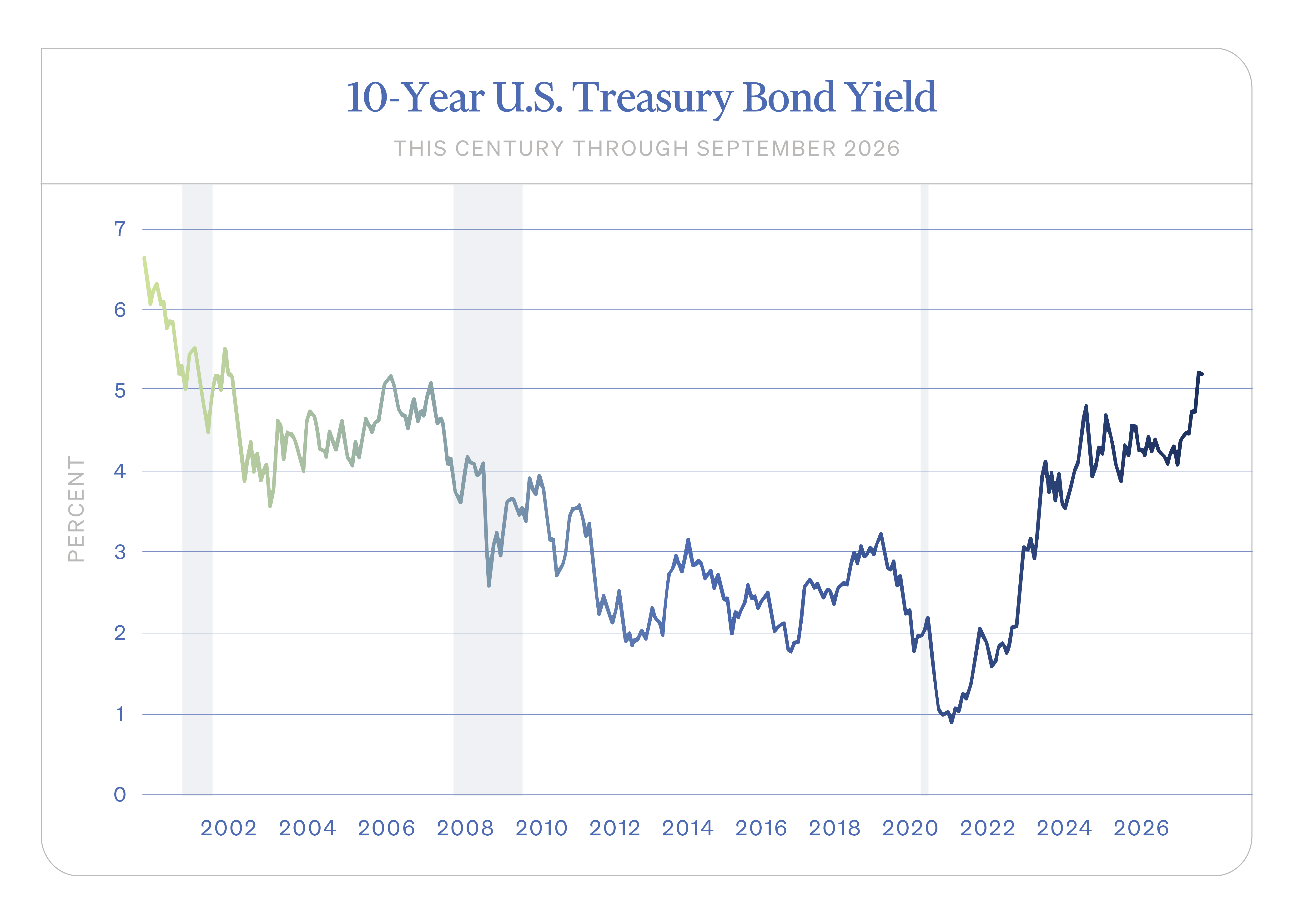
In the third quarter, the 10-year U.S. Treasury yield—the market’s benchmark interest rate—rose 0.85% to close at 5.29%. As shown below, this is its highest level in 24 years, though it remains below its long-term average of 5.80%. 1
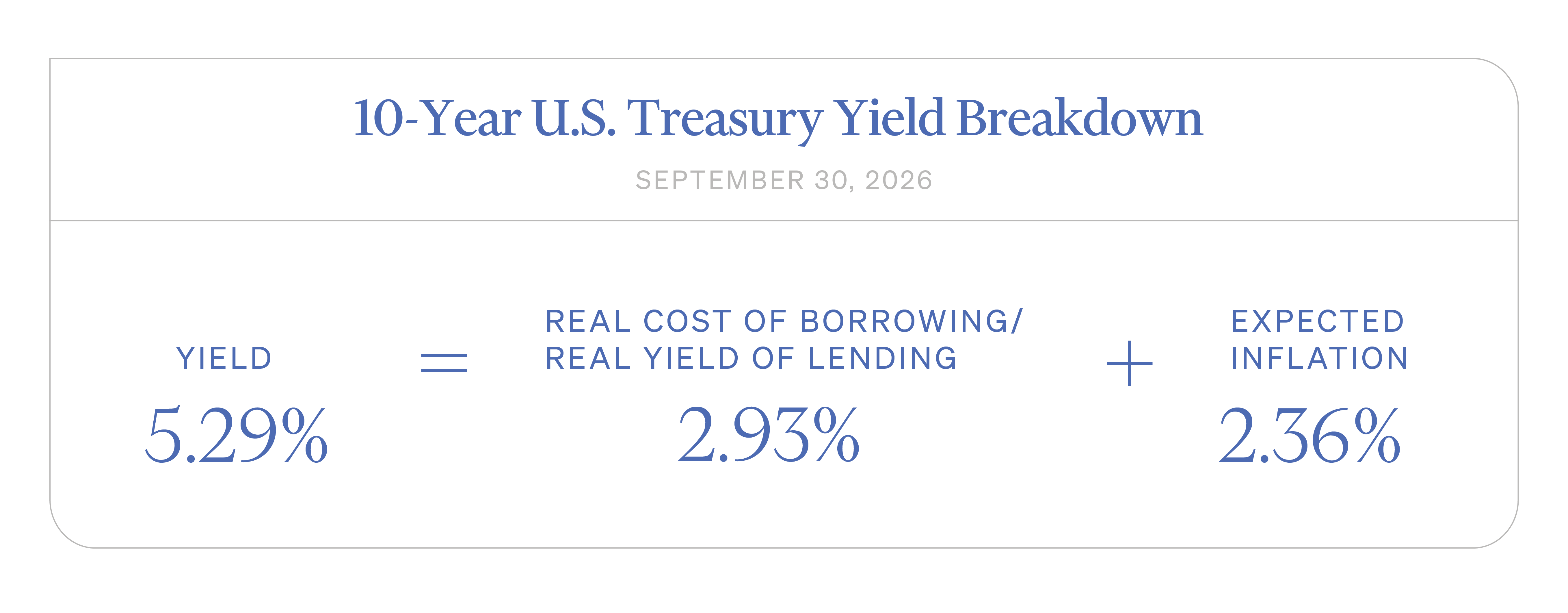
A bond yield consists of two components: the real yield plus expected inflation. The real yield reflects the supply and demand dynamics between lenders and borrowers before accounting for inflation. Treasury Inflation-Protected Securities (TIPS) track this real rate. During the quarter, the 10-year TIPS yield rose 0.73% to 2.93%, showing that real yields drove most of the increase in borrowing costs. The remaining 0.12% rise reflects a modest increase in 10-year inflation expectations.
This rise in real borrowing costs for the U.S. government could mark the start of a reckoning over the $40 trillion national debt, a temporary blip, or something in between. We simply cannot predict it. But should this uncertainty concern stock investors?
Admittedly, I am colored by my experience as a financial professional, which predominantly includes the current millennium, which has been punctuated by at least seven turmoils in the U.S. stock market: 2
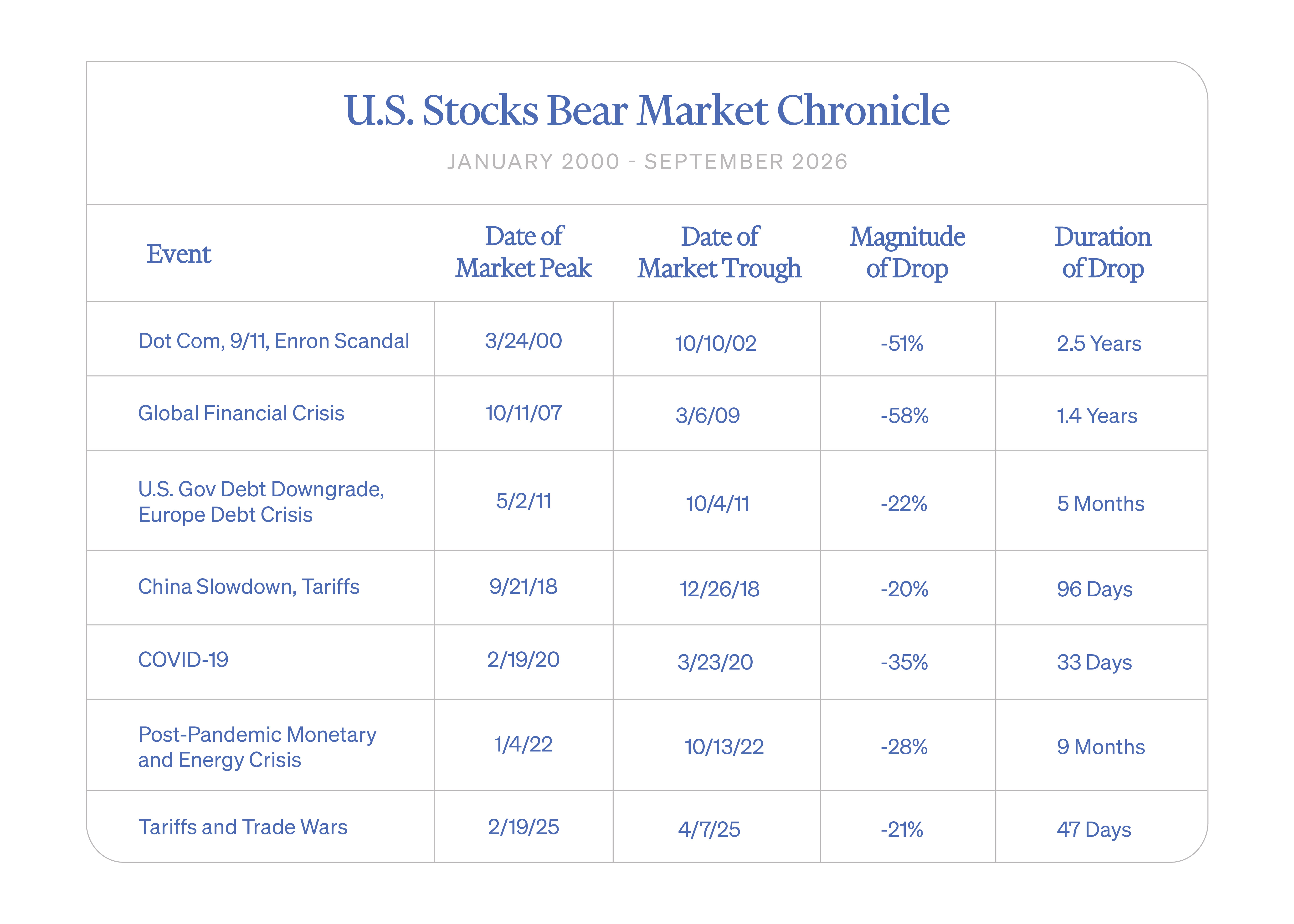
That is seven bear markets (drops of 20%+ in the S&P 500) over 26.75 years—roughly one every four years. On average, equities lost a third of their value during these downturns, with the first two erasing over half of the stock market’s value; the Global Financial Crisis marked the sharpest drop since the Great Depression. I won’t drag us through the difficult memory of each of these, though there is certainly a time and place for that.
Yet despite these declines, ownership in the 500 largest U.S. companies generated an annualized average return of 8.32% over this period .3 For long-term horizons, I remain confident in equities' ability to build wealth and meet financial goals.
The shorter term is where planning becomes essential. How do we define "short term" versus "long term"? It comes down to individual risk tolerance and determining how many years of market declines a portfolio should protect against.
When markets fall sharply, our primary goal is to avoid selling equities at depressed prices to fund withdrawals. Because market downturns vary in length, we plan around the duration of a drop rather than its depth. While history cannot predict the future, it provides a practical baseline.
Every individual investor, with their unique risk tolerance, decides for themselves what the short term and long term is by deciding how many years of withdrawals they want to insulate using bonds. There is no right answer except the one that suits the individual investor, ideally counseled by an advisor on the trade-off: greater downside protection means holding more bonds, which lowers expected long-term growth from stocks.
Historically, recovery times vary significantly. Following the COVID-19 shock, the S&P 500 regained its prior high in roughly six months (including dividends); after the Global Financial Crisis, recovery took 4.5 years. On average, full recovery takes two to three years, which serves as our minimum recommendation for portfolio protection. Investors seeking greater safety may plan for a five-year recovery window. This framework empowers clients with an objective criterion to balance a risk management timeline against growth.
Rising interest rate environments introduce a nuance: bond prices drop as yields rise, meaning bonds can decline alongside stocks. Higher yields benefit bond investors over time, but selling recently devalued bonds could be suboptimal.
This is where thoughtful bond portfolio construction matters. By staggering or laddering bond maturities, we manage this risk:
- Short-Term Bonds: Less sensitive to rate changes. During simultaneous equity and bond declines, short-term bonds are liquidated first to satisfy income needs.
- Intermediate-Term Bonds: Given time to recover value before they are needed, they fund later withdrawals.
- Equities: Once stocks recover, we rebalance by selling appreciated equities to replenish the protective bond reserve.
A well-crafted wealth management plan relies on sound financial structure. Your Quantum advisor is always available to walk through as much—or as little—of the underlying details as you care to know!
- The Federal Reserve Bank of St. Louis, January 2, 1962 (the earliest date available) through September 30, 2026 ↩
- S&P 500 stock index daily data from Yahoo Finance; analysis performed on an intraday basis. ↩
- Dimensional Fund Advisors, January 2000 through September 2026. Dividends included; taxes not included. ↩
DISCLOSURE: Quantum Financial Advisors, LLC is an SEC registered investment adviser. SEC registration does not constitute an endorsement of Quantum Financial Advisors, LLC by the SEC nor does it indicate that Quantum Financial Advisors, LLC has attained a particular level of skill or ability. This material prepared by Quantum Financial Advisors, LLC is for informational purposes only and is accurate as of the date it was prepared. It is not intended to serve as a substitute for personalized investment advice or as a recommendation or solicitation of any particular security, strategy or investment product. Advisory services are only offered to clients or prospective clients where Quantum Financial Advisors, LLC and its representatives are properly licensed or exempt from licensure. No advice may be rendered by Quantum Financial Advisors, LLC unless a client service agreement is in place. This material is not intended to serve as personalized tax, legal, and/or investment advice since the availability and effectiveness of any strategy is dependent upon your individual facts and circumstances. Quantum Financial Advisors, LLC is not an accounting or legal firm. Please consult with your tax and/or legal professional regarding your specific tax and/or legal situation when determining if any of the mentioned strategies are right for you.
Please Note: Quantum does not make any representations or warranties as to the accuracy, timeliness, suitability, and completeness, or relevance of any information prepared by an unaffiliated third party, whether linked to Quantum’s website or blog or incorporated herein, and takes no responsibility for any such content. All such information is provided solely for convenience purposes only and all users thereof should be guided accordingly.
For more information about Quantum and this article, please read these important disclosures.
- Note from the CIO
- Investment Management

Darius Gagne, PhD, CFP®, CFA
Darius Gagne is the Chief Investment Officer of Quantum Financial Advisors, LLC. Darius is also a Financial Advisor directly to clients and a founding partner of the firm.
Read More